Seeing Is Believing: How Amazon Rekognition Became the Eyes of Enterprise AI

Most people have interacted with computer vision without realizing it. The app that scans your face to unlock your phone. The checkout camera that flags shoplifted items. The platform that blurs your background on a video call. The system that stops your child from seeing inappropriate content online. Computer vision is everywhere, and for years building it meant hiring a team of deep learning engineers, assembling a GPU cluster, curating a labeled dataset of millions of images, and running training jobs for weeks. Only the largest technology companies could afford to do it properly.
Amazon Rekognition changed that equation. It distilled years of Amazon's internal computer vision research into a set of API calls that any developer can make in an afternoon. No machine learning expertise required. No training pipeline to build. No GPU infrastructure to manage. You pass an image or video, you get structured results back.
Amazon Rekognition is a cloud-based image and video analysis service that makes it easy to add advanced computer vision capabilities to applications. The service is powered by proven deep learning technology and requires no machine learning expertise to use. You can add features that detect objects, text, unsafe content, analyze images and videos, and compare faces using Rekognition's APIs. AWS
What It Actually Does
The surface area of Rekognition is wider than most people expect. This is not a single-purpose face recognition tool. It is a comprehensive computer vision platform covering several distinct capability areas.
Rekognition detects and classifies over 10,000 objects, scenes, and concepts in images, returning hierarchical labels with confidence scores and bounding boxes. It supports categories including animals, food, vehicles, furniture, landmarks, and human activities. Point it at a photo of a busy intersection and it returns not just "car" but the make, the direction of travel, whether the vehicle is moving, and where in the frame it appears, all as structured JSON your application can act on immediately. Signisys
Beyond object detection, Rekognition handles face detection and analysis, text recognition in images, celebrity identification, content moderation, and custom label training for domain-specific use cases. With Rekognition's face recognition APIs, you can detect, analyze, and compare faces for a wide variety of use cases, including user verification, cataloging, people counting, and public safety. AWS
The face comparison capability is particularly powerful for identity verification workflows. Q5id, a biometric identity company, achieved a false acceptance rate of 1 in 933 billion using Rekognition's face recognition APIs. That is not a typo. One false acceptance per 933 billion comparisons is a level of accuracy that renders manual identity verification processes not just slower but genuinely less reliable. Braincuber
The Industries Being Transformed
The breadth of Rekognition's adoption tells a story about how broadly computer vision applies across sectors that have nothing obvious in common.
In financial services, identity verification is the front door to everything. Before a customer can open an account, take a loan, or access a trading platform, the institution needs to know they are who they claim to be. Aella Credit provides easy access to credit in emerging markets using biometric, employer, and mobile phone data, using computer vision as a core part of their verification pipeline. In markets where traditional credit history does not exist, visual identity verification is not a convenience feature. It is the product. Amazon
In media and entertainment, the volume of content being generated exceeds any human moderation team's capacity. ZOZO, a Japanese fashion platform, automated image moderation for all user-generated content and cut the review process workload by 40%. OSN, a MENA media network, reduced footage needing human review by over a third. These are not small improvements. They represent entire departments being restructured around AI-assisted workflows rather than purely manual ones. Braincuber
In mapping and navigation, HERE Technologies uses Amazon Rekognition to enrich their mapping content. Rekognition's Text in Image capability allows them to continually update signage information so customers have the latest information at their fingertips. Reading street signs from camera imagery and automatically updating a living map database would have required a massive engineering effort a decade ago. Today it is an API call. Amazon Web Services
In real estate, CoStar used Rekognition's content moderation API to automatically analyze all uploaded images, ensuring platform compliance without building custom moderation infrastructure. In home security, Abode Systems used Rekognition Streaming Video Events to launch person, pet and package detection at a fraction of the cost of developing a custom computer vision service. Instead of customers receiving 100 notifications a day every time a motion sensor triggered, they receive just two or three smart notifications when an event of interest is actually present in the video stream. Amazon Web Services
Custom Labels: When Generic Models Are Not Enough
The out-of-the-box Rekognition models cover an impressive range of general categories. But enterprises frequently need to detect things that do not exist in general training datasets. A pharmaceutical company needs to identify specific pill shapes. A retailer needs to recognize their own proprietary product packaging. A logistics company needs to read custom barcodes and label formats.
Rekognition Custom Labels lets you detect custom objects such as brand logos using automated machine learning to train models with as few as 10 images. This AutoML approach, where you provide a small set of labeled examples and Rekognition handles model training and optimization automatically, brings domain-specific computer vision within reach of teams without any machine learning expertise. What used to require thousands of labeled images and weeks of training iteration now requires a folder of examples and a few hours. Amazon Web Services
The Architecture Nobody Mentions
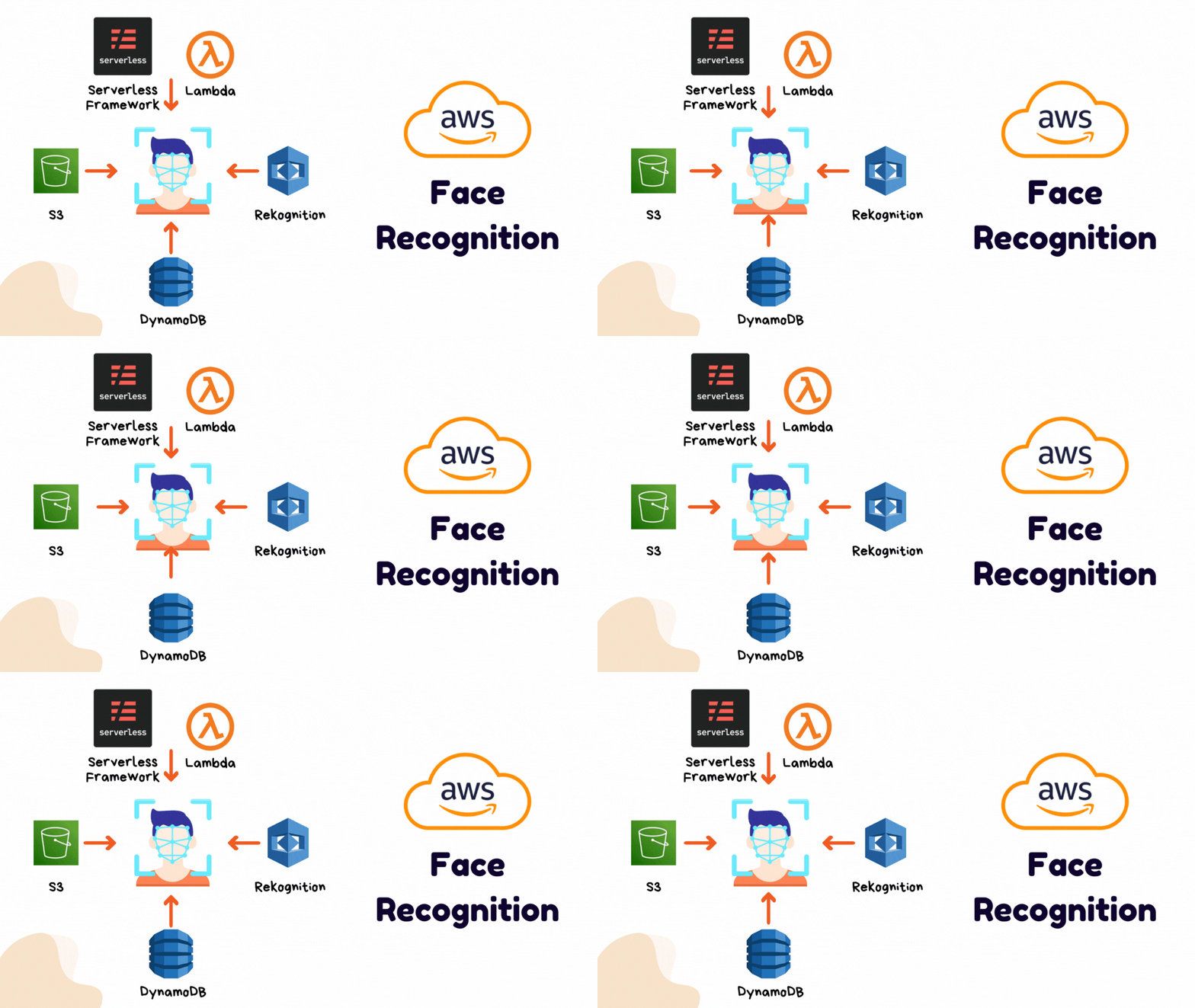
Rekognition returns structured JSON including labels, bounding boxes, confidence scores, and face attributes. Results can be stored in DynamoDB or pushed to Amazon OpenSearch for fast querying. SNS or EventBridge fires actions like alerting a reviewer, auto-tagging an asset, updating a catalog, or triggering a downstream webhook. The entire pipeline runs serverless. You pay only when assets are processed. Braincuber
This serverless event-driven architecture is what makes Rekognition genuinely practical at enterprise scale rather than just in demos. An e-commerce platform processing hundreds of thousands of product image uploads per day does not want to provision and manage a fleet of computer vision servers. With Rekognition wired to S3 events and Lambda, every image upload automatically triggers analysis, results flow into a database, and downstream systems are notified, all without a single persistent server.
Rekognition integrates out of the box with S3 and Lambda. You can call Rekognition APIs from Lambda and process images in S3 without moving data. Rekognition has built-in scalability and security using AWS IAM. AWS
The Responsible AI Question
Computer vision is not ethically neutral. Face recognition in particular has attracted serious scrutiny around accuracy disparities across demographic groups, surveillance overreach, and the risks of high-stakes decisions being made algorithmically without human oversight.
AWS has responded to these concerns with explicit guidance on threshold calibration. Rekognition's confidence scores are calibrated to help make appropriate trade-offs between accuracy and risk. For identity verification, AWS recommends using similarity thresholds of 99% or higher. For content moderation, thresholds between 60 and 80% typically balance safety with acceptable false-positive rates. Setting these thresholds appropriately and routing borderline cases to human reviewers is essential for responsible deployment. Signisys
This guidance matters. A system that automatically denies account access based on a borderline facial match without a human review path is a compliance risk and a customer experience disaster. Rekognition provides the capability. Using it responsibly requires deliberate architectural choices that the platform alone cannot make for you.
The Bottom Line
Amazon Rekognition has redefined what is possible with image and video analysis, democratizing access to advanced AI capabilities for startups and enterprises alike. By combining out-of-the-box functionality, robust security, and seamless AWS integration, it delivers actionable insights from visual content in minutes, not months. PrivateID
The companies winning with Rekognition are not those using the most sophisticated features. They are the ones who identified a specific operational problem, a backlog of identity verifications, a flood of user-generated content needing moderation, a warehouse full of products needing automatic cataloging, and applied Rekognition precisely to that problem. Computer vision does not need to be complex to be transformative. Sometimes an API call and a well-designed event pipeline is all it takes to restructure how an entire team works.